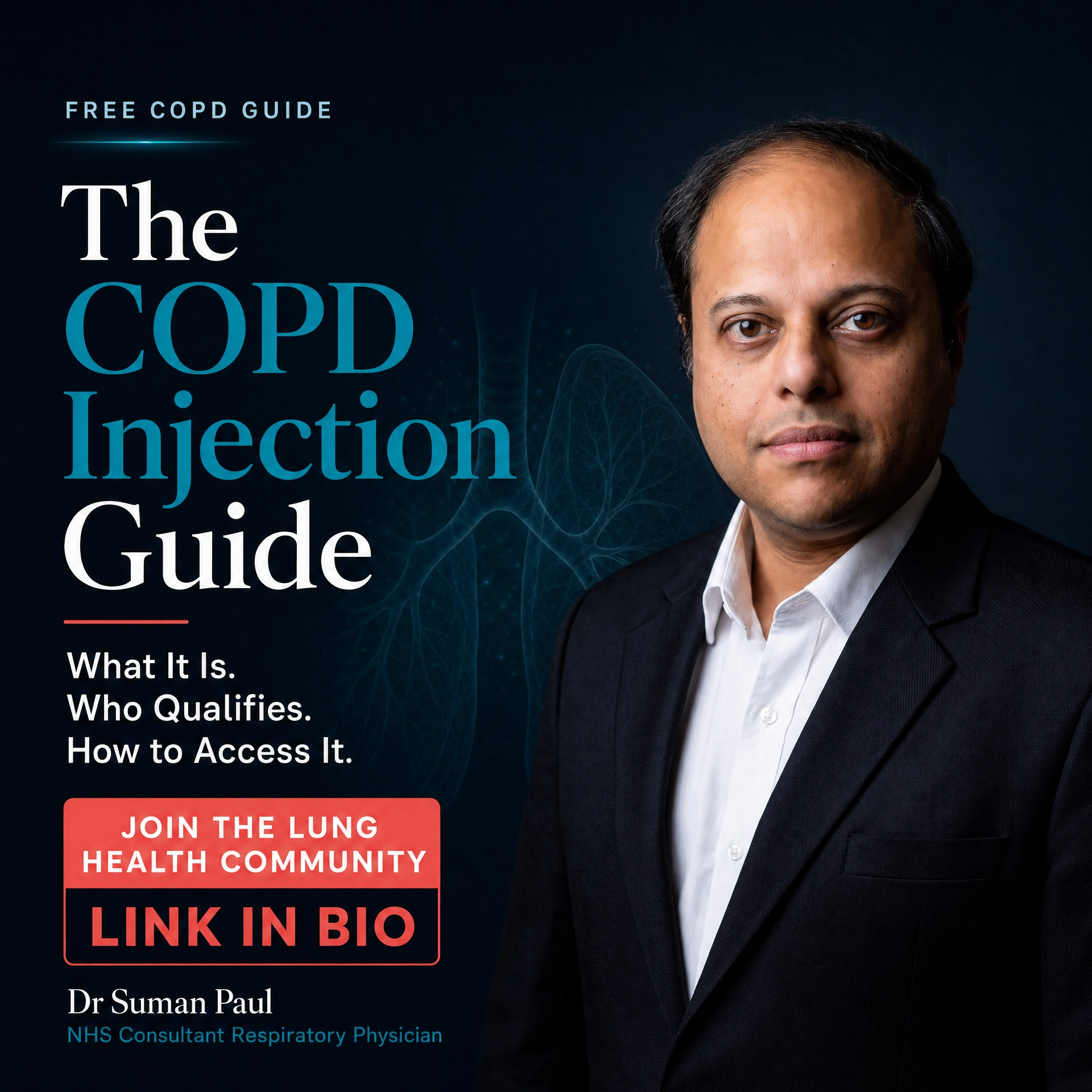
Private COPD Biologics: What They Are, Who Qualifies, and Why So Many Patients Are Choosing the Private Route
COPD treatment is evolving. For years, inhalers have been the backbone of care — and for many people, they remain essential. But a significant group of patients continue to deteriorate despite doing everything right: taking their inhalers correctly, attending reviews, avoiding triggers, and staying smoke‑free.
The reason is simple. Some COPD patients have a specific type of inflammation driven by eosinophils, a white blood cell that fuels Type 2 inflammation. Inhalers open the airways, but they do not treat this underlying inflammatory pathway. When inflammation continues unchecked, flare‑ups become more frequent, lung function declines, and hospitalisations increase.
This is where COPD biologic injections come in — one of the biggest breakthroughs in respiratory medicine in decades.
Join the lung health community and download the free guide here: Download the free Guide
What Are COPD Biologic Injections?
Biologics such as dupilumab and mepolizumab are advanced medicines designed to target the specific immune pathway driving COPD in patients with elevated eosinophils. Instead of opening the airways, they work deeper, blocking the signals that trigger inflammation.
Clinical trials show:
Fewer severe COPD flare‑ups
Improved lung function
Less breathlessness in daily activities
Reduced reliance on steroids and antibiotics
Treatment is given as a simple injection every two weeks, often self‑administered at home after initial training.
For the right patient, biologics can be genuinely life‑changing.
What Are COPD Biologic Injections?
Biologics such as dupilumab and mepolizumab are advanced medicines designed to target the specific immune pathway driving COPD in patients with elevated eosinophils. Instead of opening the airways, they work deeper, blocking the signals that trigger inflammation.
Clinical trials show:
Fewer severe COPD flare‑ups
Improved lung function
Less breathlessness in daily activities
Reduced reliance on steroids and antibiotics
Treatment is given as a simple injection every two weeks, often self‑administered at home after initial training.
For the right patient, biologics can be genuinely life‑changing.
Who Qualifies for COPD Biologics?
Biologics are not for every COPD patient. They are specifically licensed for individuals who meet three criteria:
1. A confirmed COPD diagnosis
You must have COPD formally recorded on your medical record.
2. Uncontrolled symptoms despite optimal inhalers
Even with triple‑therapy inhalers, you continue to experience flare‑ups, breathlessness, or hospitalisations.
3. Elevated eosinophils
This is the key number. A simple blood test shows whether your eosinophil count is high enough to benefit from biologic treatment.
If you meet all three criteria, you are in the group biologics were designed for.
Why Are NHS Waiting Times So Long?
Although biologics are approved and recommended, NHS respiratory services are still building the infrastructure to deliver them safely. This means many eligible patients are facing 12–18 month waits just to be assessed.
Why the delay?
New pathways require specialist training
High demand from COPD patients nationwide
Limited respiratory clinic capacity
Prioritisation of urgent or complex cases
For a progressive disease like COPD, long waits are not just frustrating — they can lead to irreversible lung damage. Every month of uncontrolled inflammation increases the risk of flare‑ups, hospital admissions, and long‑term decline.
The Private COPD Biologics Pathway: Faster, Clearer, Immediate
Private respiratory care offers a direct route to assessment and treatment — bypassing the NHS queue entirely. Patients who are deteriorating simply cannot afford to wait a year or more.
The private pathway typically includes:
1. Comprehensive face‑to‑face assessment A full review of symptoms, inhaler use, flare‑ups, and medical history.
2. Rapid diagnostic testing Immediate blood tests (including eosinophils) and spirometry.
3. Eligibility confirmed If criteria are met, biologics such as dupilumab can be prescribed privately.
4. Home delivery and ongoing specialist monitoring Medication delivered directly to your home, with regular follow‑ups to ensure safety and effectiveness.
No waiting list. No uncertainty. A clear answer within a single appointment.
Cost of Private COPD Biologics
Privately prescribed dupilumab currently costs around £1,300 per month. This is a significant investment, and patients deserve full transparency.
Is private treatment worth it?
For some, avoiding:
- repeated hospital admissions
- ongoing inflammation
- progressive lung decline is worth the cost.
For others, waiting for the NHS pathway is the right choice. The goal is to give patients clear information so they can make the decision that fits their health, finances, and priorities.
Should You Consider a Private COPD Biologics Assessment?
Ask yourself:
- Have you been hospitalised in the last 12 months despite correct inhaler use?
- Do you know your eosinophil count?
- Has anyone assessed your eligibility for biologics?
If not, a private assessment can give you clarity — fast.
Book Your Private COPD Biologics Consultation
A single face‑to‑face appointment can determine whether biologics are right for you — without waiting 12–18 months.
Clinic Locations: Liverpool | Manchester | Newton‑le‑Willows
Phone: 0161 832 2111
Email: contact@drsumanpaul.co.uk
Online: drsumanpaul.co.uk
